WISPER: From black-box AI to Knowledge-Enhanced Process Models

© Dirk Hanus / Fraunhofer ENAS
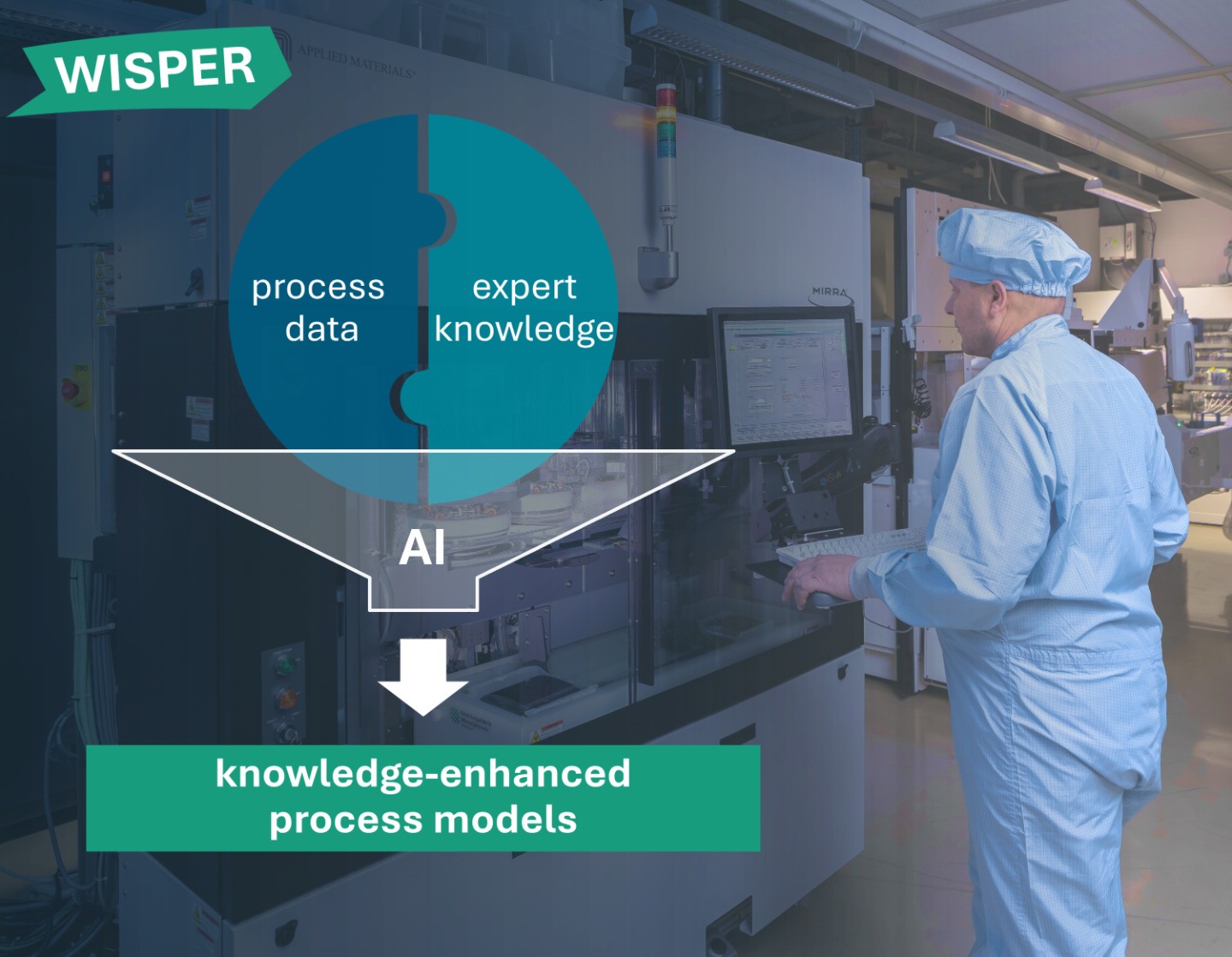
Process data and expert knowledge are combined through AI to form Knowledge-Enhanced Process Models.

Artificial intelligence (AI) has reached semiconductor manufacturing: many demonstrators now predict process outcomes. But very few deliver concrete benefits in day-to-day production. Why is that?

Modern AI tools let process engineers pragmatically build good first models themselves. However, these models often fail as soon as the process changes – when equipment components are replaced, new products are introduced, or measurements only become available with a delay. Such cases can be avoided if they are considered from the outset. This requires a structured approach and awareness of the typical pitfalls.

Data scientists bring exactly this methodological knowledge. For them, the challenge lies in grasping complex physical processes quickly and adapting their methods to them. After all, semiconductor processes differ drastically from the established AI use cases in manufacturing.


Project goal: knowledge transfer to industry

This is exactly where the WISPER project comes in: together with Chemnitz University of Technology, we are developing a continuing education program for industry that brings process engineers and data scientists together. In short talks, we show where AI projects in manufacturing typically fail – and, using concrete use cases, how to reach the goal in a structured way with our KEPM methodology. In on-site workshops, participants explore their own use cases and implement the first steps themselves.


What are Knowledge-Enhanced Process Models?

We use the term Knowledge-Enhanced Process Models (KEPM) for AI models that use not only process data but also domain knowledge from semiconductor chip manufacturing, for example physical relationships, simulations, or the experience of process engineers. This allows them to deliver accurate predictions with little data, remain reliable when processes change, and generalize to situations that do not occur in the training data.

For processes such as chemical vapor deposition (CVD), plasma etching, and chemical-mechanical planarization (CMP), we research how the necessary domain knowledge can be collected, prepared, and integrated into the models.
The KEPM methodology

Based on our project experience and building on established data science standards such as CRISP-DM, we developed the KEPM methodology together with Chemnitz University of Technology. It takes into account the special characteristics of chip manufacturing – such as the wear of equipment components, measurements arriving with a delay, and control interventions that are reflected in the data.

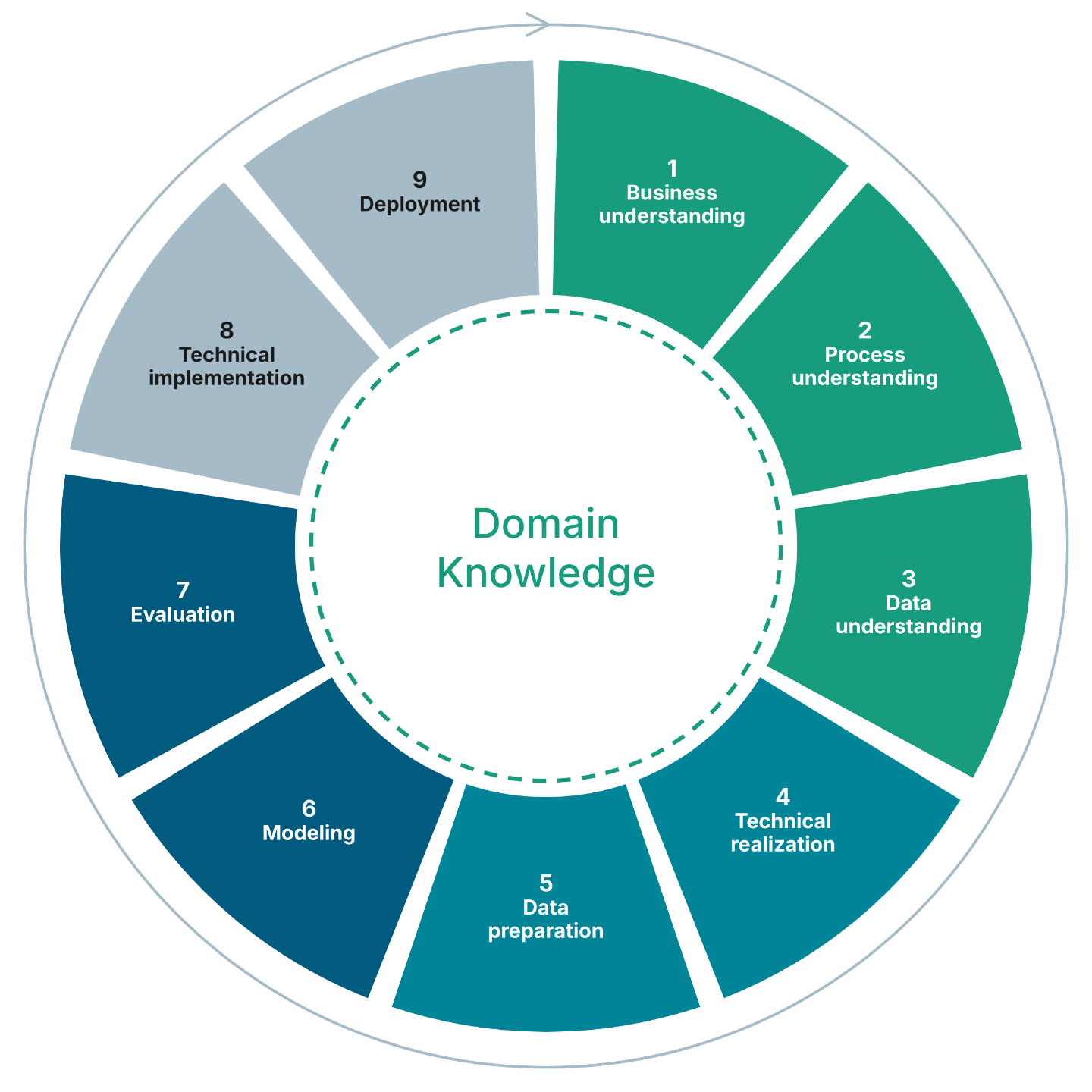
The methodology comprises nine steps in four phases – understanding, data, modeling, operation – which can be run through multiple times in practice.

Unlike in a classic data science project, the focus is primarily on understanding the business case, the process, and the data. This is also where the domain knowledge is captured that later flows into the model.

1 · Business understanding – Clarifying goals and benefits

A successful project does not begin with the intention of "doing something with AI," but with a clearly defined business case. It is worth defining the project goals together with decision-makers and process experts and determining how success can be measured – both economically and technically. For this purpose, we developed the KEPM project brief: a document that captures goals, success criteria, and constraints on a single page.

2 · Process understanding – Getting to know the process

How does the process work physically, and how is it run and controlled in the specific use case? Such questions are answered in conversation with the process experts. Our Unit Process Canvas is an interview template for these conversations that allows knowledge to be captured systematically. Because unspoken assumptions are written down, it is also valuable for experienced teams. A hypothesis tree then turns this into a prioritized work plan: Which questions must be clarified first, and which can wait?

3 · Data understanding – Getting to know the data

Many mistakes arise because data flows straight into the model and assumptions are adopted without being questioned. That is why it is essential to get to know the data first: What do the individual variables mean, how are they related, and how good is their quality? Do the expected relationships show up, and what is surprising? Already at this stage, simple models can be trained that reveal how much structure is in the data and which variables have what effect. For documentation, we follow established templates for data reports. In addition, we have developed an effect catalog that describes the typical effects in chip manufacturing data.

4 · Technical realization – Obtaining a first dataset

In this step, the goal is to obtain a first dataset that can be used for modeling – pragmatically and quickly. What matters is that it contains the information a successful model needs. To this end, the relevant manufacturing data sources are identified and combined, such as process and control data (FDC, SPC), equipment databases, maintenance logs, and metrology data. Sometimes this requires creating custom interfaces, reading proprietary file formats, or installing additional sensors. In addition, design of experiments (DoE) enriches the data: earlier or newly planned experiments generate targeted data for settings that do not occur in production.

5 · Data preparation – Preparing training data

In this step, the actual training data for modeling are created from the raw data. To do this, data quality must first be ensured. However, preprocessing goes beyond this, because it can considerably simplify modeling: with domain knowledge, physical symmetries can be exploited, data can be suitably transformed, and meaningful input variables (features) can be derived. Particularly important is a sensible split of the data: part of the data (test data) is strictly held back, and related data – such as wafers from the same product or the same tool – remain together. This avoids typical mistakes that make a model look better than it is.

6 · Modeling – Building models and integrating knowledge

Here, the first task is to select suitable models, matched to the complexity of the problem and the amount of available data. The models are then trained as efficiently as possible and their hyperparameters optimized.

What is special about Knowledge-Enhanced Process Models is that domain knowledge is also integrated into the model at this stage. We have investigated which type of knowledge (empirical equations, rules of thumb, fundamental physical equations) can best be integrated in which form (model structure, boundary conditions, prior knowledge, additional data).

7 · Evaluation – Assessing the model

In this step, the goal is to understand how good the model is and how it arrives at its predictions. In the literature, accuracy is usually the focus, and so a large part of research concentrates on increasingly accurate models. In practice, however, what also counts is how interpretable a model is, how transferable it is, how costly its operation is, and how robust it remains under changes. Robustness in particular is crucial in semiconductor manufacturing, because processes change continuously and new products are constantly being introduced. For evaluation, we use established methods and, beyond that, specially developed evaluation protocols.

8 · Technical implementation – From test model to production system

Once a model works in the test environment, it can move into production. This requires an infrastructure in which the model runs stably over a long period and is continuously supplied with live data. This includes the final software architecture: How are data captured and preprocessed, and where does the model run – on a server or directly on an edge device such as a microcontroller? Equally important are operational questions: What happens in the event of failures, and who is responsible? The sensor system must also measure reliably over months, even as sensors age.

9 · Deployment – Piloting, monitoring, readjusting

A model rarely goes directly into production. First, it goes through a pilot phase and the qualification procedures customary in industry. Even in regular operation, it must be continuously monitored to see whether it still works as expected. If not, it is adapted or retrained – and if in doubt, the entire cycle must be run through again, then with a deeper understanding of the business case, process, and data.

Interested?

We look forward to getting to know new processes and use cases and to broadening our portfolio of methods. Our offering ranges from a short talk, through small on-site workshops, to an industrial project in which we work with you to implement Knowledge-Enhanced Process Models.

Project details

WISPER is supported by the Competence Center “Smart Production and Materials” with funding of EUR 40,000.

  • Project partner: Chemnitz University of Technology
  • Duration: January 1, 2027 – December 31, 2027

Our KEPM projects


CMP Demonstrator


DaHyME: Data Management and Hybrid Process Modeling for Microelectronics


GENESIS: Generate in Europe a Sustainable Industry for Semiconductor